

A Brief History
Nuclear power generation experienced rapid expansion between the 1970s and 1990s as nations sought alternatives to fossil fuels amid oil price volatility and growing energy demand. However, nuclear power’s growth waned in the early 2000s following a series of high-profile incidents: Three Mile Island (1979), Chernobyl (1986), and Fukushima (2011), that negatively shifted public trust and reshaped political attitudes globally.
The Changing Tide
In recent years, support has grown in favour of nuclear energy. Accelerating decarbonization targets, heightened geopolitical instability in global energy markets, and the rapid growth of energy-intensive technologies such as artificial intelligence and data centers have underscored the critical need for reliable, low carbon baseload power.
The Intergovernmental Panel on Climate Change (IPCC) includes nuclear energy among the low-carbon technologies featured in its multiple scenario pathways that limit global warming to 1.5-2℃ above pre-industrial levels.
Policymakers have also shifted their attitudes toward nuclear energy. Nuclear energy has garnered bipartisan support in the United States with the passing of the ADVANCE Act of 2024, which speeds up the approval and development of advanced nuclear reactors. Nuclear energy has been a clear winner amid the Trump administration’s backlash of renewable energy as the administration aims to quadruple US nuclear energy capacity by 2050.
Nuclear Energy in Sustainable Investing
Both North American and European sustainable funds are increasingly removing long-standing exclusions against nuclear investments. This shift is driven by the growing recognition of nuclear’s role in meeting dual goals of energy security and net zero emissions.
Projections show that nuclear investment remains steady under the current policies but rises sharply if countries follow through on their announced pledges, and even more so in a net zero emissions by 2050 scenario. In all cases, spending peaks in the 2030s as new projects and reactor life extensions ramp up, then gradually tapers toward 2050 once most construction is complete. Regardless of which scenario will prove to be reality, we believe the outlook is clear: the need for nuclear energy as a scalable, low-carbon energy source is understood and anticipated at a global level.
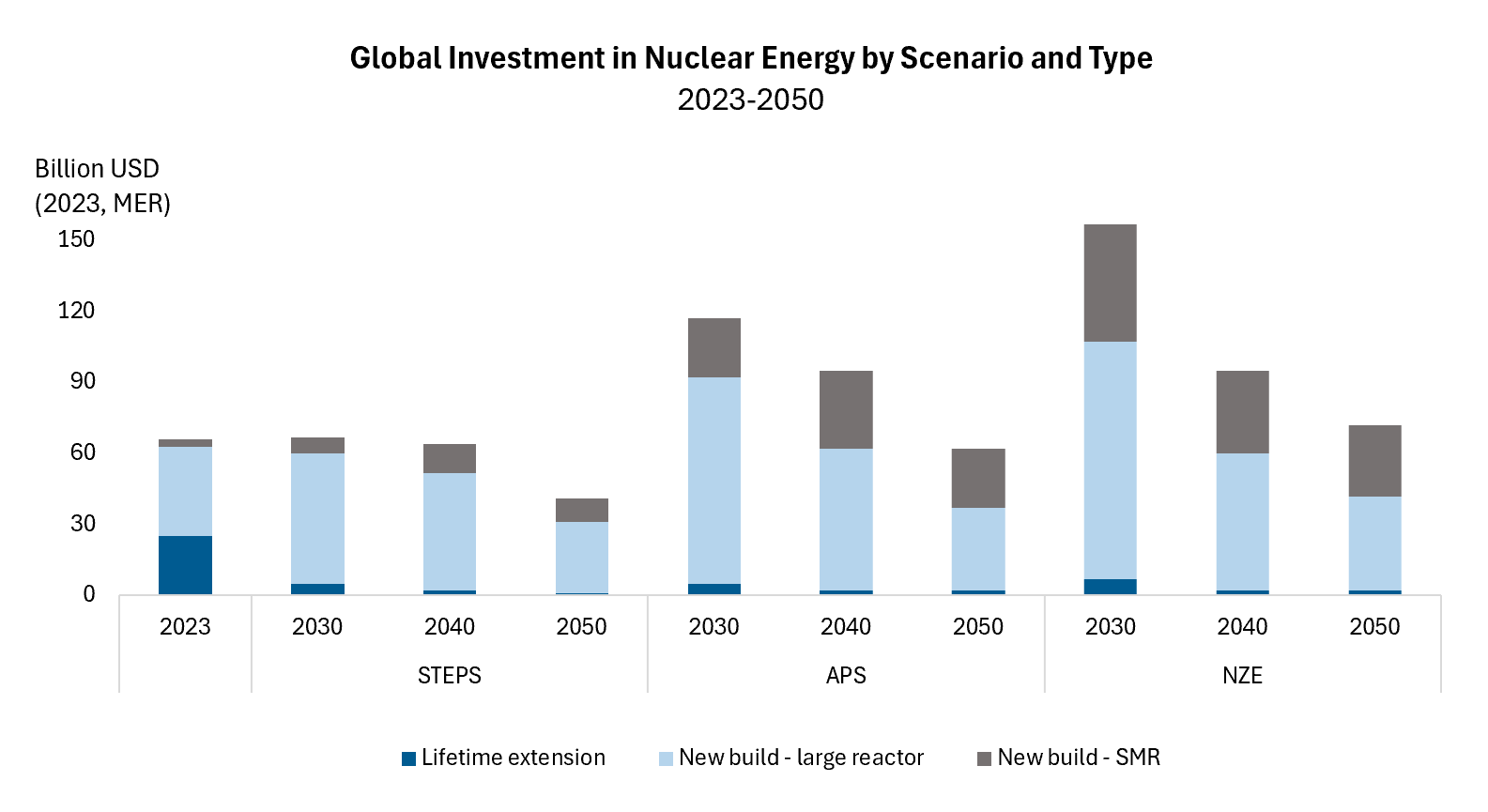
Notes: MER = market exchange rate; SMR = small modular reactor; STEPS = Stated Policies Scenario; APS = Announced Pledges Scenario; NZE = Net Zero Emissions by 2050 Scenario. Source: IEA (2024), World Energy Outlook 2024.
In 2022, the EU taxonomy labelled certain nuclear activities as “transitional,” provided that strict technical criteria and waste-disposal safeguards were made. Teollisuuden Voima Oyj, a Finnish power producer, debuted the first EU green bond from the nuclear sector and saw more than 3.5x investor orders for the €500 million deal. This deal marks a milestone for Europe’s green debt market, marrying the introduction of Europe’s Green Bond Standard and the inclusion of nuclear power.
RPIA's Approach to Nuclear Power Generation
RP Broad Corporate Bond (Fossil Fuel Exclusion) strategy applies a focused exclusionary approach within the Energy sector by excluding Natural Gas Distribution, Oil & Gas Exploration, Integrated Oil & Gas, and Oil & Gas Pipeline, while removing the Generation sub-category from the exclusions.
Although the Energy Generation sub-category includes a broad range of electricity and power producers, issuers with any fossil fuel involvement remain screened out under the fund’s other exclusion criteria. What remains eligible are electricity and power generation companies without oil and gas revenues, such as renewables and nuclear, which aligns with the strategy’s mandate.
This adjustment broadens the opportunity to include high-quality nuclear energy issuers focused on delivering reliable, low-carbon power. A recent example is BPC Generation Infrastructure Trust (BGIT), the holding company through which OMERS invests in Bruce Power. BGIT recently completed its inaugural C$1.5 billion bond issuance, supporting the long-term operations of the Canadian nuclear operator. We view this transaction as a favourable and timely investment opportunity that underscores strong investor confidence in the sector’s attractive fundamentals.
Sources
1. U.S. Energy Information Administration. “Following the Fukushima nuclear accident, Japan shut down nearly all of its nuclear reactors.” Today in Energy. March 2023. https://www.eia.gov/todayinenergy/detail.php?id=55559
2. Ritchie, Hannah, et al. “Nuclear Energy.” Our World in Data. Accessed September 2025. https://ourworldindata.org/nuclear-energy
3. Morningstar. “Can Nuclear Power Fit in a Sustainable Portfolio?” Sustainable Investing. Accessed September 2025. https://www.morningstar.com/sustainable-investing/can-nuclear-power-fit-sustainable-portfolio
4. Jenkins, Jesse D. “A Critical Disconnect: Nuclear Energy in Climate Finance.” Center on Global Energy Policy, Columbia University. September 2023. https://www.energypolicy.columbia.edu/publications/a-critical-disconnect-relying-on-nuclear-energy-in-decarbonization-models-while-excluding-it-from-climate-finance-taxonomies/
5. International Energy Agency. “A New Era for Nuclear Energy Beckons.” IEA Newsroom. June 2023. https://www.iea.org/news/a-new-era-for-nuclear-energy-beckons-as-projects-policies-and-investments-increase
6. U.S. Nuclear Regulatory Commission. “About the ADVANCE Act.” NRC.gov. 2023. https://www.nrc.gov/about-nrc/governing-laws/advance-act/about-advance-act.html
7. U.S. Department of Energy. “Key Takeaways from Executive Orders on Nuclear Energy.” Energy.gov. 2017. https://www.energy.gov/ne/articles/9-key-takeaways-president-trumps-executive-orders-nuclear-energy
8. BBC. “Nuclear Energy: The Shifting Global Debate.” BBC News. September 2025. https://www.bbc.com/news/articles/cx25v2d7zexo
9. RBC Capital Markets. “Energy Security Is Reshaping Sustainable Investing.” RBC Capital Markets Insights. July 2025. https://www.rbccm.com/en/story/story.page?dcr=templatedata/article/story/data/2025/07/energy-security-is-reshaping-sustainable-investing
10. European Parliamentary Research Service. “Taxonomy and Nuclear Energy: The EU Debate.” Briefing 698935. January 2022. https://www.europarl.europa.eu/RegData/etudes/BRIE/2022/698935/EPRS_BRI(2022)698935_EN.pdf
11. Bloomberg News. “Finnish Nuclear Firm Tests EU Green Bond Standard.” Bloomberg. September 8, 2025. https://www.bloomberg.com/news/articles/2025-09-08/finnish-nuclear-firm-tests-eu-green-bond-gold-standard-with-sale
12. International Energy Agency. The Path to a New Era for Nuclear Energy. May 2025. https://iea.blob.core.windows.net/assets/b6a6fc8c-c62e-411d-a15c-bf211ccc06f3/ThePathtoaNewEraforNuclearEnergy.pdf
Important Information
The information herein is presented by RP Investment Advisors LP (“RPIA”) and is for informational purposes only. It does not provide financial, legal, accounting, tax, investment, or other advice and should not be acted or relied upon in that regard without seeking the appropriate professional advice. The information is drawn from sources believed to be reliable, but the accuracy or completeness of the information is not guaranteed, nor in providing it does RPIA assume any responsibility or liability whatsoever. The information provided may be subject to change and RPIA does not undertake any obligation to communicate revisions or updates to the information presented. Unless otherwise stated, the source for all information is RPIA. “Forward-Looking” statements are based on assumptions made by RPIA regarding its opinion and investment strategies in certain market conditions and are subject to a number of mitigating factors. Economic and market conditions may change, which may materially impact actual future events and as a result RPIA’s views, the success of RPIA’s intended strategies as well as its actual course of conduct. The information presented does not form the basis of any offer or solicitation for the purchase or sale of securities. Products and services of RPIA are only available in jurisdictions where they may be lawfully offered and to investors who qualify under applicable regulation. RPIA managed strategies and funds carry the risk of financial loss. Performance is not guaranteed and past performance may not be repeated.
RPIA is a signatory of the UN Principles for Responsible Investment and as part of our commitment, we consider Environmental, Social & Governance (“ESG”) factors as part of our firm-level activities, including our investment process. ESG factors are important considerations in our investment management process but is supplemental to our primary financial and credit research and analysis functions. ESG factors that may be considered as part of our investment process include matters relating to climate change, energy use, energy efficiency, emissions, waste, pollution, matters related to human rights, impact on local communities, labour practices, employee working conditions, health and safety of the employees and affiliates, employee relations and diversity, executive compensation, bribery and corruption, board independence, board composition and diversity, alignment of interest between the shareholders and the executives, shareholder rights, and companies’ policies relating to ESG.
ESG integration, including components relating to issuer engagement, is a firm-wide investment approach but the weight and importance of it in our investment management process can vary across the investment funds we manage. Always refer to the relevant fund offering documents for important information on the investment objectives, strategies and associated risks of a particular fund. The consideration and implementation of ESG factors are also subject to RPIA’s internal investment and risk management policies and may be revised as a result of investment suitability requirements, current portfolio positioning and external market and economic factors.
The consideration of ESG factors in the investment process for RPIA managed mutual funds, including RP Strategic Income Plus Fund, RP Target 2026 Discount Bond Fund, RP Alternative Global Bond Fund and RP Alternative Credit Opportunities Fund is limited and weighted less than the primary financial and credit analysis employed in the management of these funds. Please see the fund’s simplified prospectus for important information about the investment objectives, strategies and risks of each fund. Commissions, trailing commissions, management fees and expenses all may be associated with mutual fund investments. Please read the prospectus before investing. Mutual funds are not guaranteed, their values change frequently and past performance may not be repeated. Always consult with your registered investment dealer before investing in mutual funds.