

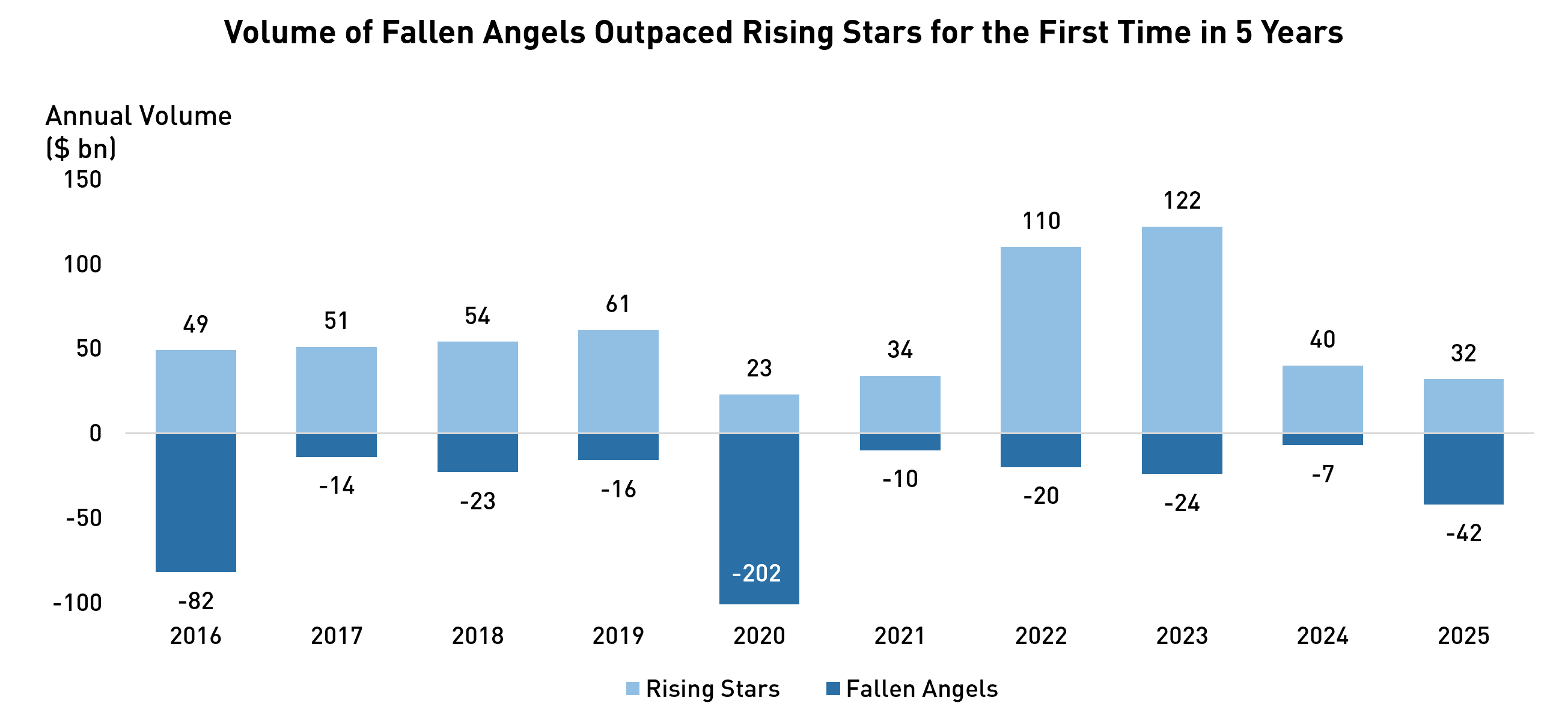
1. 2025 Saw More Fallen Angels Than Rising Stars, the First Time Since 2020
Looking ahead, we expect market outcomes to become increasingly two-directional. This environment should create opportunities to actively express negative views, particularly through short positions and CDS in issuers facing deteriorating fundamentals or secular decline.
Source: Bloomberg, Barclays. Data as of October 24, 2025.
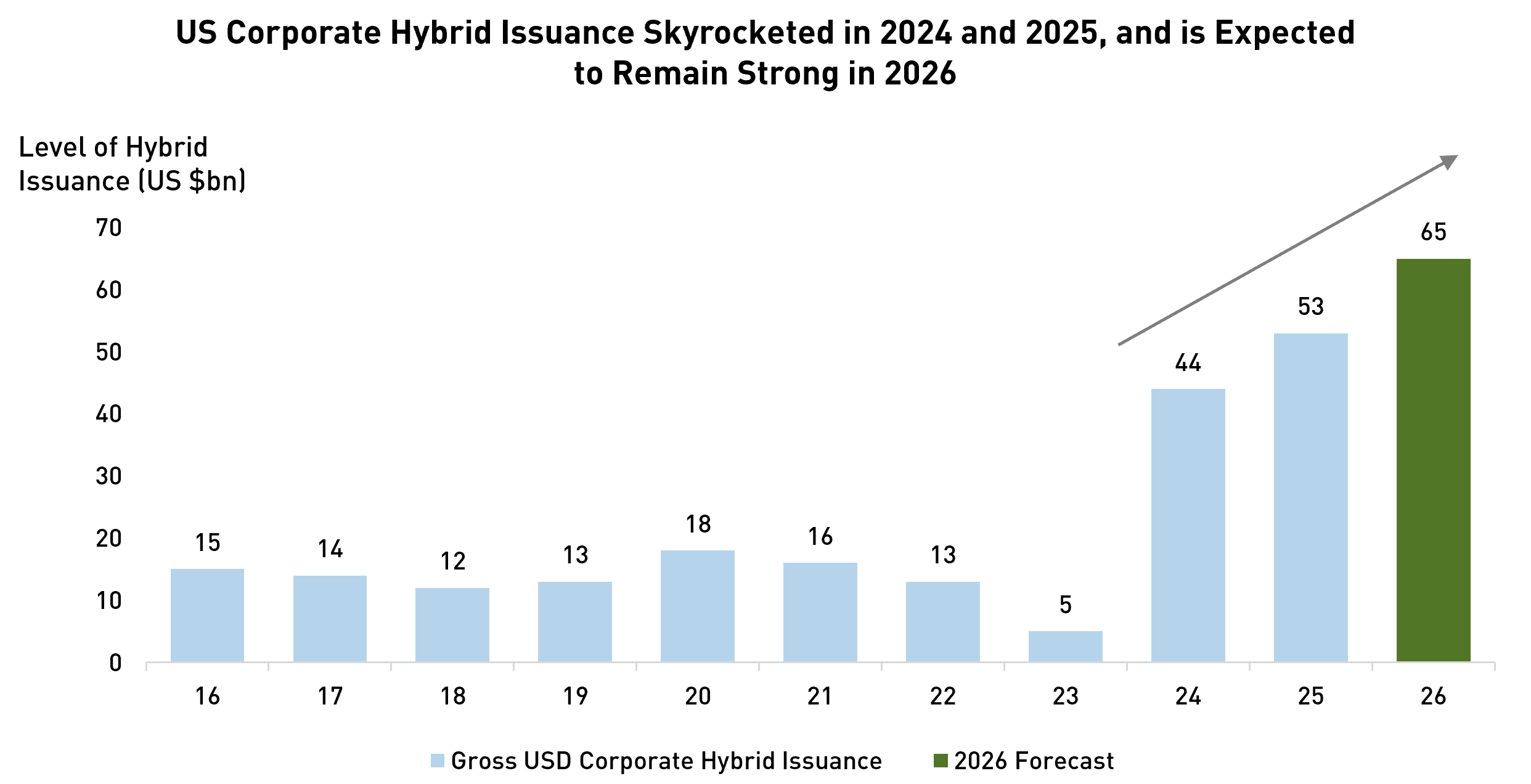
2. Corporate Hybrid Issuance Hit Another Record High In 2025
We believe this momentum will continue in 2026, with corporate hybrids taking up a larger share of both the investment-grade and high yield bond markets. We will selectively participate in hybrid deals where structure and carry are attractive.
Source: Barclays. Data as of December 3, 2025.
3. Signs of Stress Emerge in Private Debt Markets
Although we do not view liquidity as a near-term risk for most private credit issuers, we remain cautious of the asset class overall. Wider spreads increase funding costs for BDCs, and the predominant floating-rate structure introduces additional downside risk if US rates decline further in 2026. If sentiment remains weak, these pressures could persist, particularly in lower-quality segments of private credit.

Source: Bloomberg, Barclays. Data as of December 31, 2025. NAV data for Q4 2025 has not been released at the time of this report.
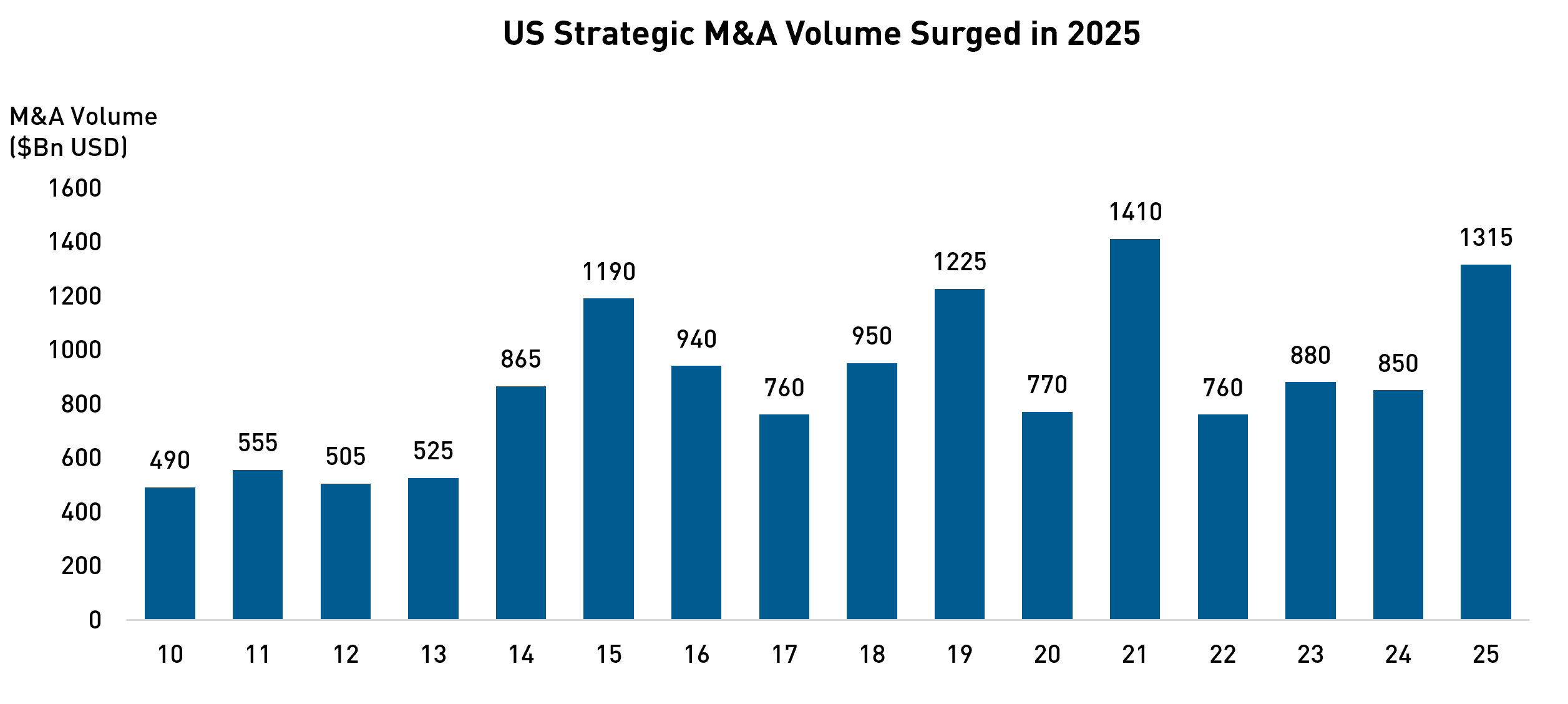
4. Elevated M&A Activity Supports a Credit Picker’s Market in 2026
M&A activity closed 2025 at a historic pace, with announced US deal value reaching $1.3 trillion – up 55% year-over-year. M&A often serves as a meaningful catalyst for bond price volatility, as target companies can experience significant spread changes from deal announcement all the way to completion. For example, in September 2025, Electronic Arts agreed to be taken private by Saudi Arabia’s Public Investment Fund, pushing its 6-year bond price to rise from $88 to $95 within a week.
At the same time, M&A activity can also increase dispersion in credit fundamentals as some acquirers enhance earnings and scale while others stretch balance sheets and face downgrade risk. We believe this strong pipeline of acquisition-driven issuance should keep 2026 a credit picker’s market, offering attractive opportunities in catalyst-driven, idiosyncratic situations.
Source: Goldman Sachs, Bloomberg. Data as of December 5, 2025. Strategic M&A defined as acquisitions or mergers undertaken primarily to advance a company’s long-term competitive strategy - such as expanding capabilities, entering new markets, gaining scale, or reshaping the business mix – rather than for near-term financial optimization.
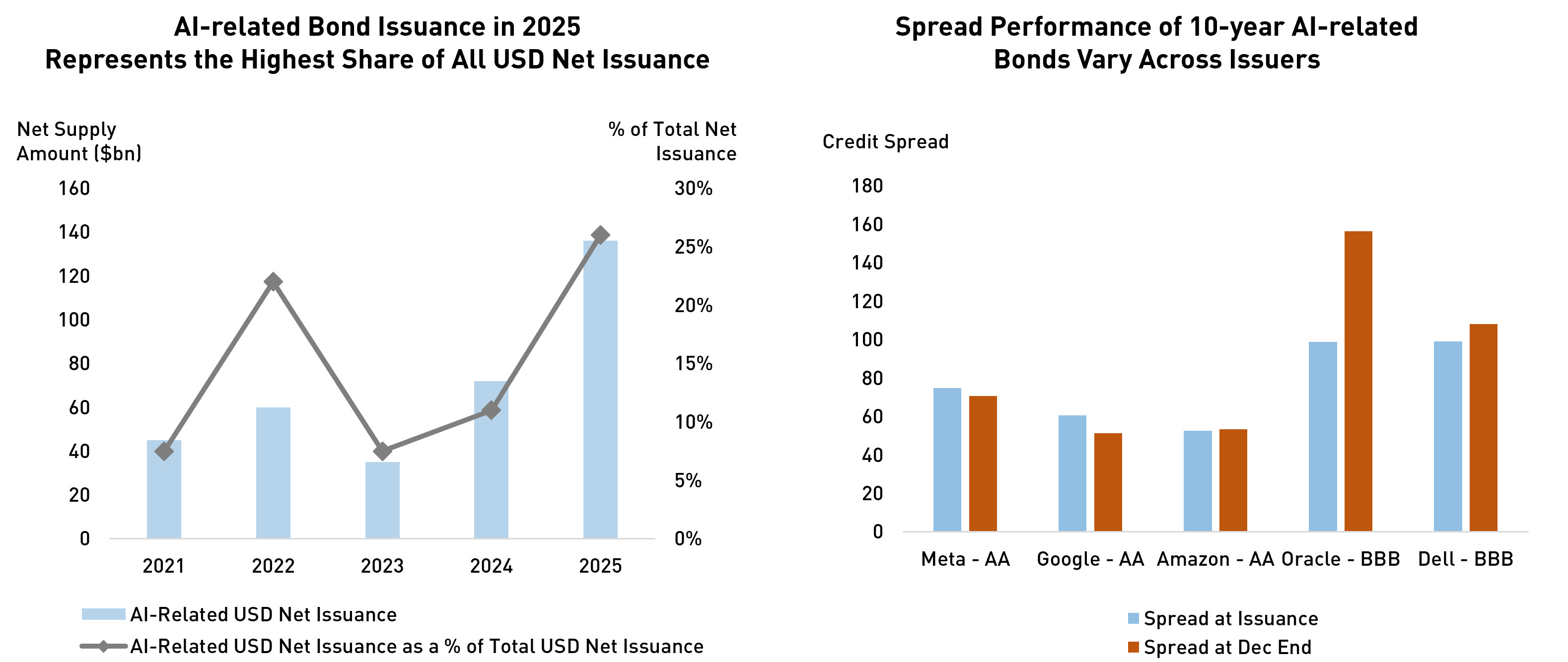
5. AI Issuance Led News Headlines, but Credit Spread Performance Varied
We are approaching these new issues selectively on a deal-by-deal basis. It remains to be seen how much of the funding is issued in the private vs. public credit markets.
Source: Goldman Sachs, Bloomberg. Data for Net Issuance as of December 6, 2025, Data for BDC redemption as of December 31, 2025. Bond included: META 4.875 11/15/2035, GOOGL 4.7 11/15/2035, AMZN 4.65 11/20/3035, ORCL 5.95 09/26/2035, DELL 5.1 02/15/2036.
Important Information
The information herein is presented by RP Investment Advisors LP (“RPIA”) and is for informational purposes only. It does not provide financial, legal, accounting, tax, investment, or other advice and should not be acted or relied upon in that regard without seeking the appropriate professional advice. The information is drawn from sources believed to be reliable, but the accuracy or completeness of the information is not guaranteed, nor in providing it does RPIA assume any responsibility or liability whatsoever. The information provided may be subject to change and RPIA does not undertake any obligation to communicate revisions or updates to the information presented. Unless otherwise stated, the source for all information is RPIA. The information presented does not form the basis of any offer or solicitation for the purchase or sale of securities. Products and services of RPIA are only available in jurisdictions where they may be lawfully offered and to investors who qualify under applicable regulation. The RPIA managed investment strategies discussed herein may be available to qualified Canadian investors through private and/or publicly offered investment funds. Eligibility and suitability of investing in these funds must be determined by registered dealing representatives of RPIA or third-party dealers.
“Forward-Looking” statements are based on assumptions made by RPIA regarding its opinion and investment strategies in certain market conditions and are subject to a number of mitigating factors. Economic and market conditions may change, which may materially impact actual future events and as a result RPIA’s views, the success of RPIA’s intended strategies as well as its actual course of conduct. Security and trade examples are presented for illustrative purposes and do not necessarily reflect a trade or current holding in any particular RPIA managed strategy or fund.