

1. Record High M&A Activities Can Unlock More Catalyst-Driven Opportunities
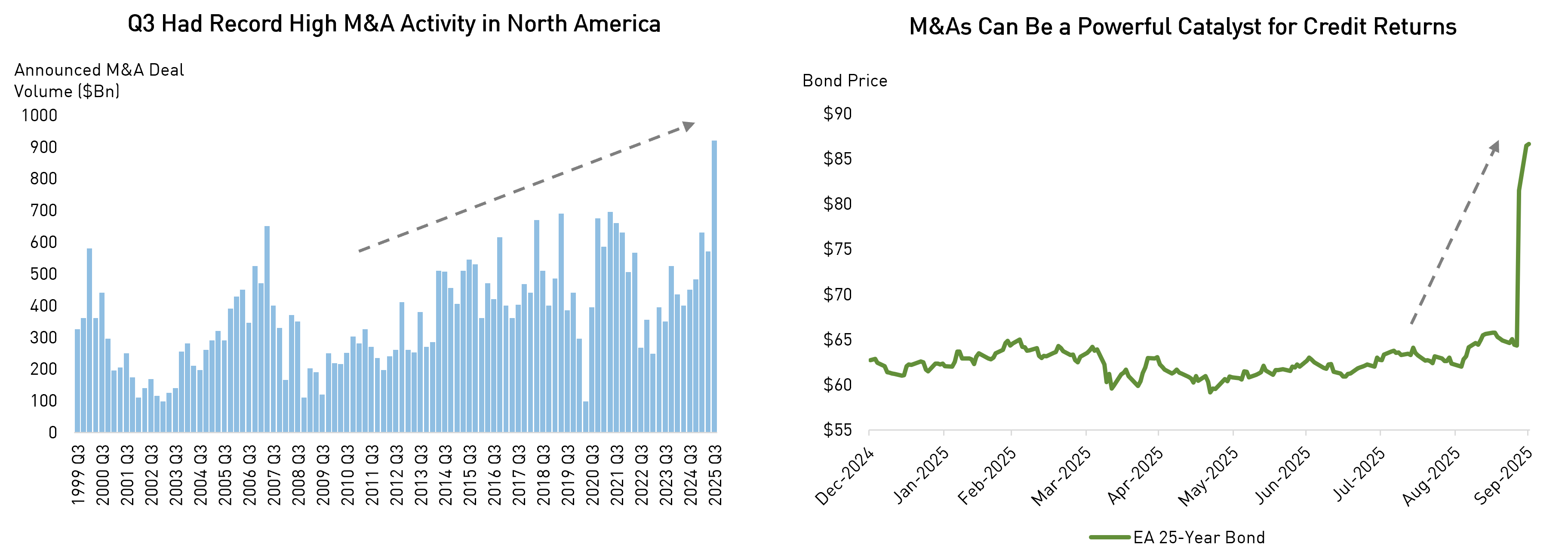
M&A activity in North America surged in Q3 with a two-decade high of $920bn in deals announced during the quarter. Elevated deal flows can create a fertile ground for active credit managers to add value.
M&As can be viewed as “credit negative” as firms typically increase leverage to enhance equity returns, but these events can also create compelling security-specific opportunities. For instance, when Saudi Arabia’s Public Investment Fund announced a take-private deal for Electronic Arts (“EA”), the company’s long bonds rallied more than 30% due to a “change of control” clause that suggests they will likely be taken out at par. While we did not participate in the EA deal, we are actively monitoring for these idiosyncratic opportunities as M&A activity remains elevated.
Source: BofA Securities, Goldman Sachs Global Investment Research. Data as of September 18, 2025.
2. Elevated Credit Spread Dispersion in US IG Bonds Supports Active Trading
Since 2024, the prevailing narrative has been that “credit spreads are tight.” However, the past 12 months have seen a notable increase in dispersion around the average spread level in US investment-grade bonds, despite the index’s tight valuation. This is encouraging for active managers as greater dispersion creates opportunities to capitalize on price dislocations. Notably, the spread dispersion is particularly elevated for BBB-rated credits, the largest and most liquid segment of corporate bond markets.
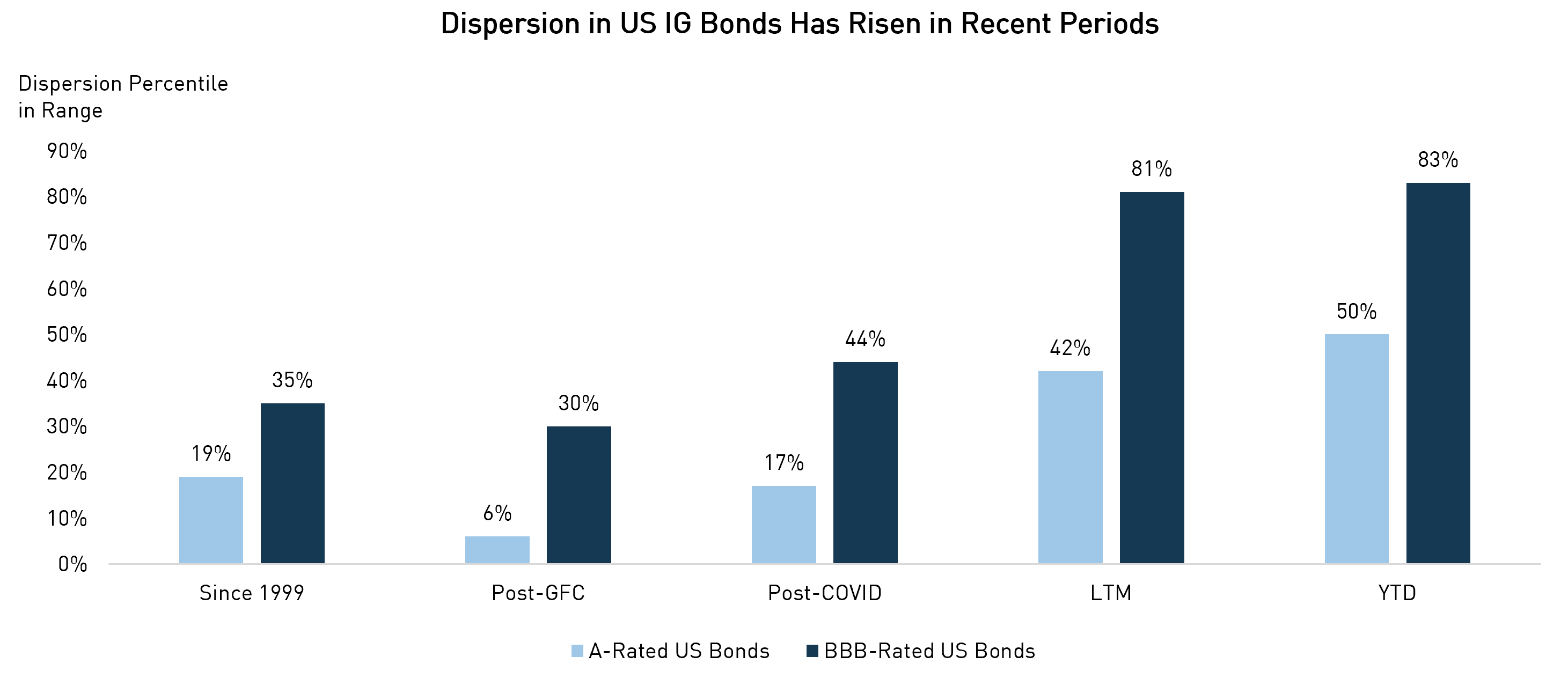
Source: Barclays. As of September 19, 2025. Dispersion is calculated by taking the standard deviation of bond-level OAS (i.e., all of the bonds in the index but winsorized – excluding the top/bottom 1% of bonds by OAS), and then dividing by the average OAS on a daily basis.
3. Private Markets Face Growing Concerns Amid Increased Defaults
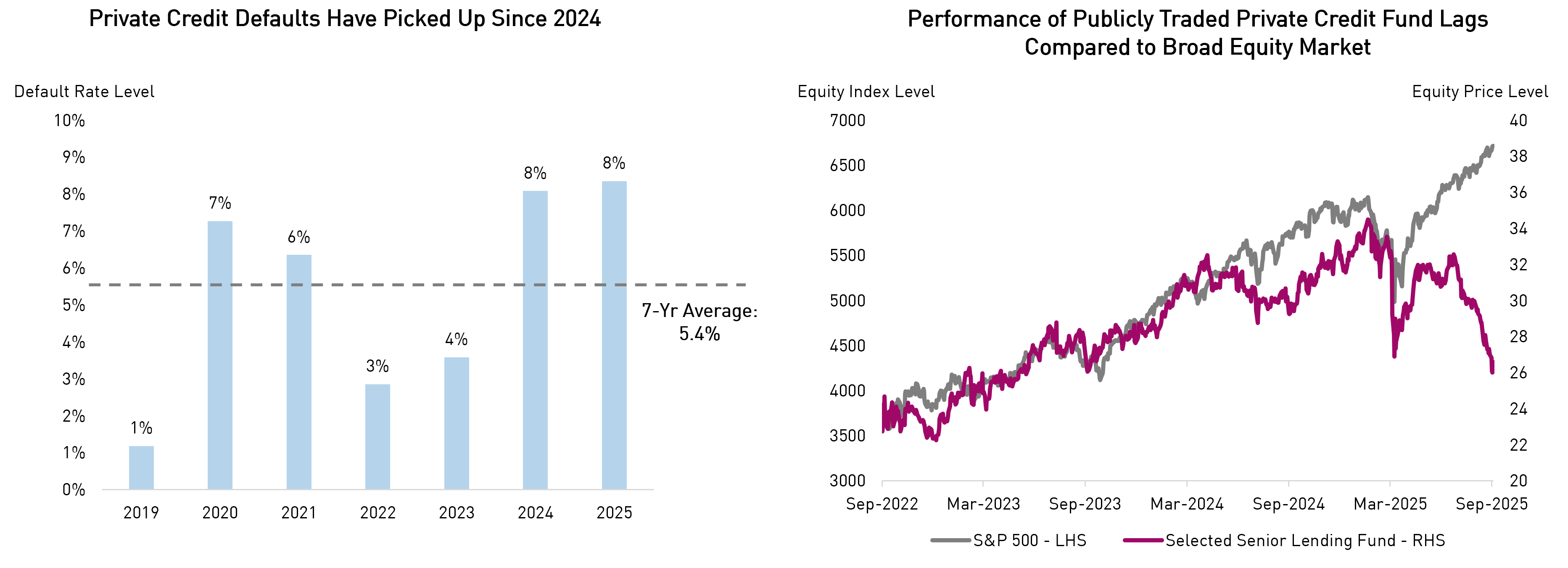
This year, default rates in the US private credit market have climbed above 8%, accompanied by several private credit firms gating redemptions. At the same time, there has also been a significant divergence in performance between the S&P 500 and publicly listed BDCs, which are often seen as a proxy for private credit portfolios. We believe this performance lag is indicative of growing investor concerns around valuations and the risks of further private debt defaults.
Source: Fitch Ratings, Bloomberg. Default rate data as of August 30, 2025; Equity price data as of September 30, 2025.
4. Diverging Rates Trajectories Across Regions are Driving a Shift in Issuer Funding Choices
As rates have fallen in Europe but stayed elevated in the US, the gap in funding costs for global issuers has widened. In response, many global issuers have shifted their financing source by tapping the Euro market more heavily while reducing their USD bond issuance. This shift will likely broaden the opportunity set with an expanded Euro issuer universe and enhanced market liquidity.
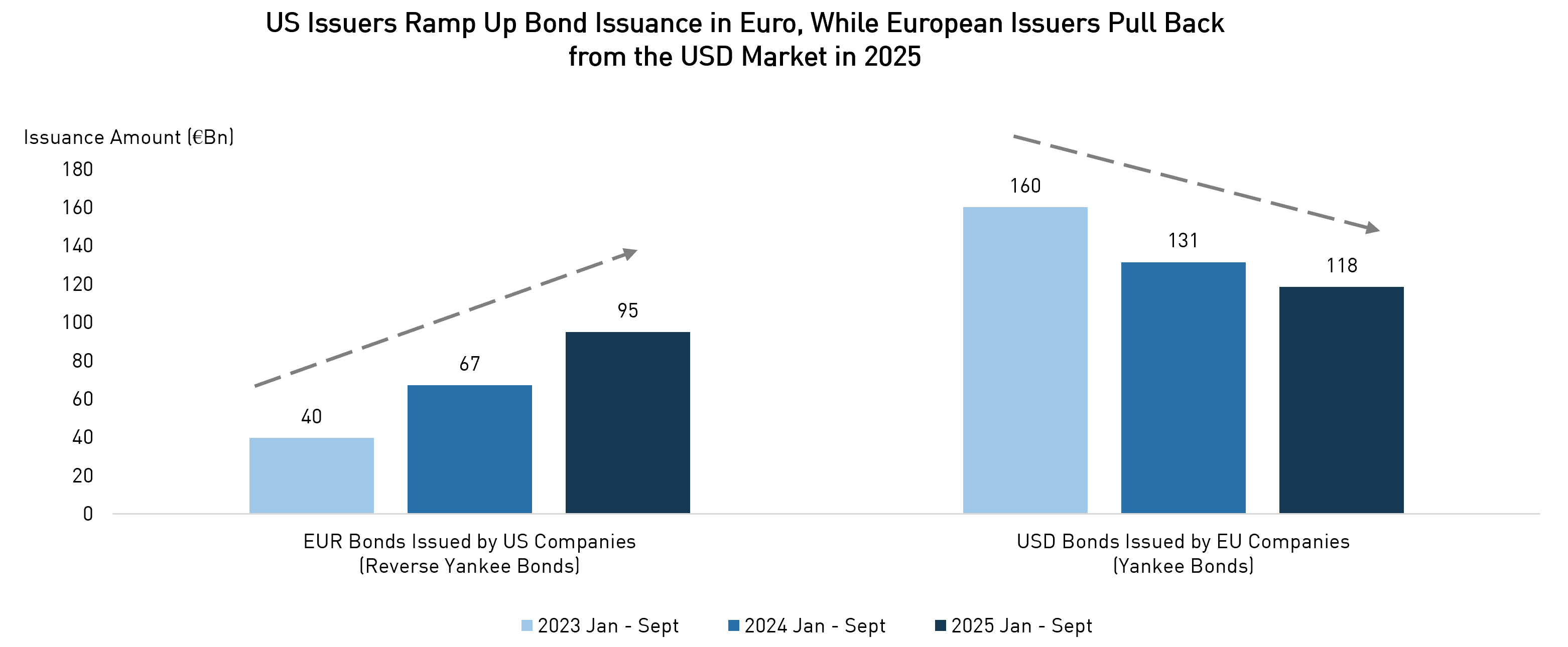
Source: TDSI. Data as of October 1, 2025. Issuance focuses exclusively on new issuance and excludes taps from existing bonds.
5. Political Turmoil Results in Negative Credit Spreads in French Issuers
In a reversal of past trends, Italy is now viewed as a higher-quality sovereign borrower than France. This shift stems largely from growing concerns over France’s fiscal sustainability, which have pushed French government yields higher. As a result, many high-quality French corporates are trading at lower yields than the sovereign itself, indicating a negative credit spread. A notable example is luxury conglomerate LVMH. Given the ongoing political uncertainty in France, we are maintaining a highly selective approach to French exposure in our portfolios.

Source: Goldman Sachs Global Investment Research, Bloomberg. Data as of September 30, 2025.
Important Information
The information herein is presented by RP Investment Advisors LP (“RPIA”) and is for informational purposes only. It does not provide financial, legal, accounting, tax, investment, or other advice and should not be acted or relied upon in that regard without seeking the appropriate professional advice. The information is drawn from sources believed to be reliable, but the accuracy or completeness of the information is not guaranteed, nor in providing it does RPIA assume any responsibility or liability whatsoever. The information provided may be subject to change and RPIA does not undertake any obligation to communicate revisions or updates to the information presented. Unless otherwise stated, the source for all information is RPIA. The information presented does not form the basis of any offer or solicitation for the purchase or sale of securities. Products and services of RPIA are only available in jurisdictions where they may be lawfully offered and to investors who qualify under applicable regulation. RPIA managed strategies and funds carry the risk of financial loss. Performance is not guaranteed and past performance may not be repeated.
Commissions, trailing commissions, management fees and expenses all may be associated with mutual fund investments. Please read the prospectus before investing. Indicated rates of return include changes in share or unit value and reinvestment of all dividends or distributions and do not take into account sales, redemption, distribution or optional charges or income taxes payable by any securityholder that would have reduced returns. Returns for time periods of more than one year are historical annual compounded total returns while returns for time periods of one year or less are cumulative figures and are not annualized. Mutual funds are not guaranteed, their values change frequently and past performance may not be repeated. The compound growth chart is used only to illustrate the effects of a compound growth rate and is not intended to reflect future values or returns of the Fund.
The index performance comparisons presented are intended to illustrate the historical performance of the indicated strategies compared with that of the specified market index over the indicated period. The comparison is for illustrative purposes only and does not imply future performance. There are various differences between an index and an investment strategy or fund that could affect the performance and risk characteristics of each. Market indices are not directly investable and index performance does not account for fees, expense and taxes that might be applicable to an investment strategy or fund. “Forward-Looking” statements are based on assumptions made by RPIA regarding its opinion and investment strategies in certain market conditions and are subject to a number of mitigating factors. Economic and market conditions may change, which may materially impact actual future events and as a result RPIA’s views, the success of RPIA’s intended strategies as well as its actual course of conduct.